
Borboleta Monarca
credits: Richard Hurd/Flickr
Em 1975, depois de uma longa pesquisa de décadas que envolveu milhares de voluntários que atravessaram um continente inteiro, Ken Brugger e Catalina Trail descobriram um dos mais belos mistérios da natureza: o lugar hibernação da borboleta monarca.

Google Doodle 41º Aniversário Descoberta da
Montanha das Borboletas
Doodler: Kevin Laughlin
O motor de busca Google apresenta na sua página de entrada de países como Estados Unidos, Peru, Argentina, França, entre outros) um Doodle criado por Kevin Laughlin para celebrar o 41º aniversário da descoberta da Montanha das Borboletas, no México, pelos ambientalistas Ken Brugger and Catalina Traile. Os países em que o Doodle é exibido traçam o percurso da borboleta monarca.
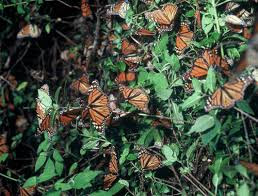
Monarch Butterfly Biosphere Reserve (Mexico)
créditos: Carlos Gottfried
Em 1975, depois de uma longa pesquisa de décadas que envolveu milhares de voluntários que atravessaram um continente inteiro, Ken Brugger e Catalina Trail descobriram um dos mais belos mistérios da natureza: o lugar hibernação da borboleta monarca.
Conduzido por uma equipe de geólogos canadianos sob Fred Urquhart, o casal seguiu pistas deixadas por borboletas marcadas que se desviaram ou caíram na suas viagens migratórias rumo ao sul.

Monarch Butterfly Biosphere Reserve (Mexico)
créditos: Carlos Gottfried
A cena, em que milhões de borboletas-monarca se agarram às árvores Oyamel na Montanha Sierra Madre, México, teria sido esmagadora.
"Elas rodavam pelo ar como folhas de outono", disse Urquhart depois de ter visto pela primeira vez, "tapetando o chão em suas miríades de fogo na encosta da montanha mexicana."
A reserva ecologista Monarch Butterfly Biosphere Reserve (Mexico) faz parte de Unesco World Heritage desde 2008.
One of the natural world's most fascinating mysteries, the Mountain of Butterflies, celebrates its 41st anniversary today, the 9th January with a Doodle. Google presents Doodle created by the artitst Kevin Laughlin. The discovery has been celebrated today by a Google Doodle on the search engine's homepage.
The Doodle leads to a search for what is the mountain of butterflies. The Doodle has a limited reach, only posted on Google homepages for the U.S., Mexico, parts of South America and Europe, along with a few other countries, including Kenya, Malaysia, Japan and Iceland, following the trail of the migratory journeys south of the monarch butterfly.
The discovery of the overwintering place of the graceful monarch butterfly had taken several decades of searching by thousands of volunteers.

Oyamel tree
In 1975, after a decades long search that involved thousands of volunteers and spanned an entire continent, Ken Brugger and Catalina Trail unlocked one of nature’s most beautiful mysteries: the overwintering place of the monarch butterfly. Ken Brugger and Catalina Trail's determination helped the team led by the Canadian Fred Urquhart find the answers they had been looking for.
The couple followed clues left by tagged butterflies that had strayed or fallen on their migratory journeys south. The butterflies attach themselves to oyamel trees in the Sierra Madre Mountains, in eastern Mexico.
The monarch butterfly is under threat due to climate change and deforestation in the country, where the species migrates to from the the US and Canada in winter.
The scene, in which millions of monarchs cling to oyamel trees in Mexico’s eastern most Sierra Madre Mountains, would have been overwhelming. “They swirled through the air like autumn leaves,” said Urquhart after his first visit, “carpet[ing] the ground in their flaming myriads on the Mexican mountainside.”
Artist Kevin Laughlin recognizes the 41st anniversary of an incredible discovery and the singularly awesome beauty of the monarch butterfly.
The Monarch Butterfly Biosphere Reserve (Mexico) is a Unesco World Heritage site
Monarch Butterfly Biosphere Reserve (Mexico)
créditos: Lincoln P. Brower
The 56,259 ha biosphere lies within rugged forested mountains about 100 km northwest of Mexico City.
Every autumn, millions, perhaps a billion, butterflies from wide areas of North America return to the site and cluster on small areas of the forest reserve, colouring its trees orange and literally bending their branches under their collective weight.

Monarch Butterfly Biosphere Reserve (Mexico)
créditos: Carlos Gottfried
In the spring, these butterflies begin an 8 month migration that takes them all the way to Eastern Canada and back, during which time four successive generations are born and die. How they find their way back to their overwintering site remains a mystery.
Discover more here
Geração 'green'
09.01.2016


